

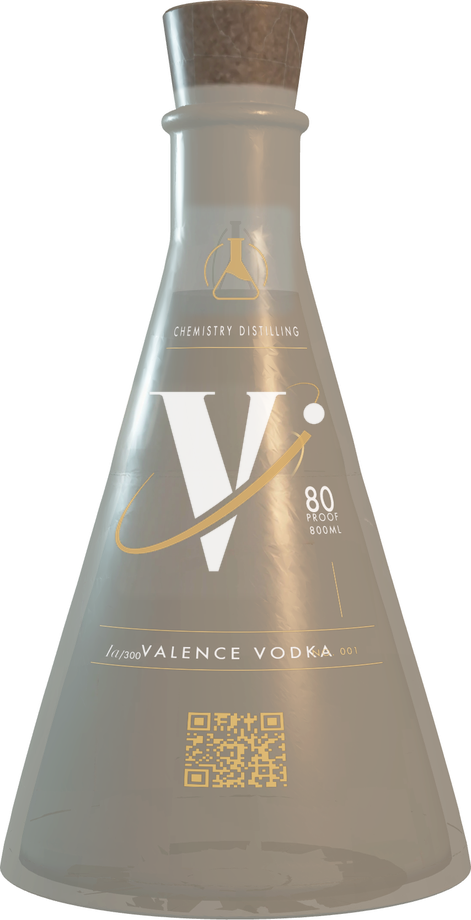
Experiment № 1 · Released
Valence Vodka
Clean by design. Collected from the controlled center of an advanced separation process.
The full storyVerification required
Are you 21 years of age or older?
Please drink responsibly. By entering you confirm you are of legal drinking age in your location.
 Valence
A working distillery · An experimental laboratory
Clean by design · Rapid City, SD
Follow the process
01 · Select
Our process is unique in that we distill less pure, dry 200-proof spirit — not a dilute wash. Every finished product begins with the quality of its raw material, so we evaluate the spirit before it ever enters the separation system.
02 · Separate
We first prefractionate, then finish, in two distinct distillation columns. There are no plates inside — highly engineered structured packing. We don't distill in batches, but to compare: the process is the equivalent of a 50× distilled vodka. Because we understand how impurities behave in dry alcohol at varying pressures and temperatures, we take advantage of an advanced separation method.
03 · The clean center
This is not a batch of "runs" with heads and tails. It is a continuous separation: light impurities purge from the top, heavy impurities purge from the bottom, and the pure, clean spirit returns from the middle of the finishing column — continuously.
04 · Measure
Temperatures and pressures are controlled continuously, and gas chromatography every four hours confirms the spirit keeps meeting purity spec — impurities removed to the part-per-million level, 99.9999% pure.
05 · Polish
To further refine and smooth Valence Vodka, a continuous polishing step circulates the spirit through coconut-shell activated carbon until flavor, mouthfeel, and aroma are balanced.
06 · Bottle
Vodka has never been produced this way — the product is one of a kind. Every bottle begins as an experiment. This one is Batch № VA-001.
Every bottle begins as an experiment.
Experiment № 1 · Released
Clean by design. Collected from the controlled center of an advanced separation process.
The full storyExperiment № 2 · In development
Can the interactions of wood, oxygen, heat, and time be understood — and intentionally controlled?
Hypothesis stageExperiment № 3 · In development
Botanicals, fruit, grain, and wood — flavor depends on how ingredients are treated, not just chosen.
Hypothesis stageAdvanced separation, explained without the lecture. Light compounds out the top, heavy out the bottom — we keep the clean center.
Explore the processIn development: guided experiments you will be able to run at home with household items and a bottle of Valence. Change one variable. Observe.
See what's comingBatch № VA-001 is bottled and available by request. Scan the code on the bottle and it brings you here.
Find a bottleSpirits, reconsidered
Most spirits begin with the same familiar tools: fermentation, heat, distillation, barrels, and time. Chemistry Distilling begins with those traditions — then asks,what else is possible? We are not rejecting tradition. We are studying it, testing it, and building on it.
Temperatures, pressures, densities — the process is monitored and adjusted with data.
Every idea becomes a hypothesis. Every batch becomes an experiment.
Instruments tell us a spirit is clean. People tell us it is good.
The Chemistry Lab · in development
We're building a set of guided experiments anyone can perform at home with household items and a bottle of Valence — change one variable at a time, observe the result. It's being vetted in our own lab first. Join the list and you'll hear when it opens.
New batches, new results, and the lab as it opens. Follow along.
Join the mailing list